Viscosity Notes 5#
These are some supporting notes for the document Effective Viscosity.
Viscosity#
We now model viscosity through a dissipation term in the “springs”. The idea is that there is a resisting force \(F_{\beta}(\delta q, \delta \dot{q})\) that depends on the extension of the spring \(\delta q\) and the velocity \(\delta \dot{q}\):
E.g., we can generate a Lamé viscosity:
Details
I was not sure how to first express this, so I went back to the idea
In other words:
etc.
We consider the following two cases:
The first is the simple viscosity, while the second is a Lamé viscosity with power \(\alpha = 1\). In both cases:
In the first case, we must have
This has no solutions since \(g(\delta q)\) should be independent of \(\delta \dot{q}\). In the second case
This is as we stated above.
from scipy.integrate import solve_ivp
from scipy.interpolate import InterpolatedUnivariateSpline

class Particles:
    Ns = 32  # Number of springs
    g_m2 = 1.0  # Coupling constant over mass^2
    R = 1.0  # Initial radius
    beta = 0.0  # Dissipation
    nu = 0.0    # Lame viscosity

    def __init__(self, **kw):
        for key in kw:
            if not hasattr(self, key):
                raise ValueError(f"Unknown {key=}")
            setattr(self, key, kw[key])
        self.init()

    def init(self):
        x0 = np.arange(0, self.Ns+1)/self.Ns
        q0_R = get_q_R(x0)
        self.q0 = self.R * q0_R
        self.m = 4*self.R**3/3/self.Ns
        self.dq0 = 0*self.q0
        self.x0 = np.linspace(-self.R, self.R, self.Ns+1)

    def pack(self, q, dq):
        return np.ravel([q, dq])

    def unpack(self, y):
        return np.reshape(y, (2, y.shape[0]//2) + y.shape[1:])

    def V(self, dq, d=0):
        g = self.g_m2 * self.m**2
        if d == 0:
            return g/2/dq
        elif d == 1:
            return -g/2/dq**2

    def compute_dy_dt(self, t, y):
        q, dq_dt = self.unpack(y)
        dq = np.concatenate([[0], np.diff(q), [0]])
        dV = np.concatenate([[0], self.V(np.diff(q), d=1), [0]])
        ddq_dt = np.concatenate([[0], np.diff(dq_dt), [0]])
        f = self.m * self.nu * ddq_dt/dq**2
        f[0] = f[-1] = 0
        #ddq_dt2 = (dV[1:] - dV[:-1]) / self.m + self.beta * (dv[1:] - dv[:-1])
        ddq_dt2 = (dV[1:] - dV[:-1] + (f[1:] - f[:-1])) / self.m
        return self.pack(dq_dt, ddq_dt2)

p1 = Particles(Ns=32)
p2 = Particles(Ns=256)
ps = [p1, p2]
y0s = [p.pack(p.q0, p.dq0) for p in ps]
T = 2.0
Nt = 100
t_eval = np.linspace(0, T, Nt)
ress = [solve_ivp(p.compute_dy_dt, y0=y0, t_span=(0,T), t_eval=t_eval, method="LSODA")
        for p, y0 in zip(ps, y0s)]
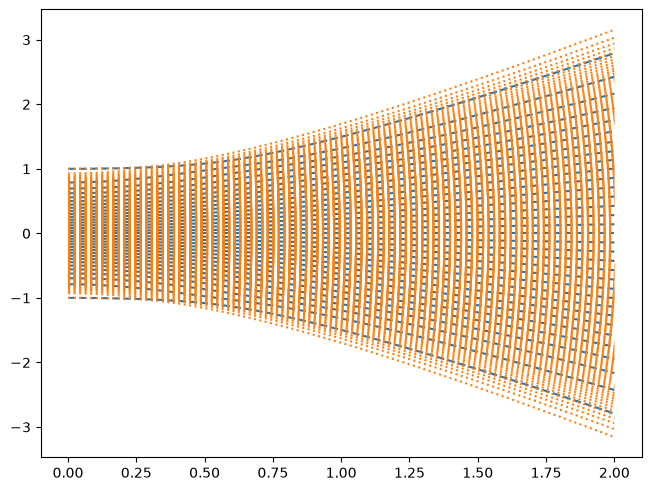
for res, fmt in zip(ress, ['--C0', ':C1']):
    q, dq = p2.unpack(res.y)
    plt.plot(res.t, q.T, fmt);
/tmp/ipykernel_5224/3235063741.py:44: RuntimeWarning: invalid value encountered in divide
  f = self.m * self.nu * ddq_dt/dq**2
Nt = len(t_eval)
rhos = []
xs = []
xlim = [0,0]
rho_max = 0
for p, res in zip(ps, ress):
    q, dq = p.unpack(res.y)
    rho = p.m/np.diff(q, axis=0)
    x = (q[1:] + q[:-1])/2
    xlim = [min(xlim[0], x.min()), max(xlim[1], x.max())]
    rho_max = max(rho_max, rho.max())
    rhos.append(rho)
    xs.append(x)

args = dict(xlim=xlim, ylim=(0, rho_max))
fig, ax = plt.subplots()
for i in FPS(Nt, fig=fig, embed=True, fps=10):
    ax.cla()
    for j, p in enumerate(ps):
        ax.plot(xs[j][:, i], rhos[j][:, i])
    t = t_eval[i]
    ax.set(title=f"t={res.t[i]:.4f}", **args)
Here is the Lagrangian hydrodynamic description for comparison:
import scipy.fft
sp = scipy

class Flow:
    Nx = 128
    A = 0.5      # g/2/m^2
    nu = 0.04    # Viscosity coefficients

    def __init__(self, **kw):
        for key in kw:
            if not hasattr(self, key):
                raise ValueError(f"Unknown {key=}")
            setattr(self, key, kw[key])
        self.init()

    def init(self):
        self._th0 = (2*np.arange(self.Nx) + 1) * np.pi / 2 / self.Nx
        self._k = np.arange(self.Nx)
        self.x0 = np.cos(self._th0)

        # Initial density profile
        self.n0 = 0*self.x0 + 1.0
        self.n0_x0 = 0*self.x0

        self.n0 = (1-self.x0**2)
        self.n0_x0 = -2*self.x0

    def get_y0(self):
        X0 = self.x0
        Xt0 = 0*X0
        return self.pack(X0, Xt0)

    def diff(self, f, d=1):
        ft = sp.fft.dct(f, type=2, norm='forward')
        th, k = self._th0, self._k
        s = np.sin(th)

        # Shift the coefficients and pad with zero.
        df_dth = sp.fft.dst(np.concatenate([-(ft*k)[1:], [0]]), type=3)
        if d == 1:
            df_dx = -df_dth / s
            return df_dx
        else:
            d2f_dth2 = sp.fft.idct(-ft*k**2, type=2, norm='forward')
            d2f_dx2 = (d2f_dth2 - df_dth / np.tan(th)) / s**2
            if d == 2:
                return d2f_dx2
            return self.diff(df_dx, d=d-2)

    def pack(self, X, X_t):
        return np.ravel([X, X_t])

    def unpack(self, y):
        return np.reshape(y, (2, self.Nx))

    def unpack_xnu(self, y):
        X, X_t = self.unpack(y)
        X_x0 = self.diff(X)
        n = self.n0 / X_x0
        u = X_t
        x = X
        return x, n, u

    def get_a_ext(self):
        return 0

    def compute_dy_dt(self, t, y):
        X, X_t = self.unpack(y)
        X_x0 = self.diff(X)
        X_x0x0 = self.diff(X, d=2)
        n = self.n0 / X_x0
        n_x = self.n0_x0 / X_x0**2 - self.n0 * X_x0x0 / X_x0**3
        X_tx0 = self.diff(X_t)
        u_x = X_tx0/X_x0

        u_xx = (self.diff(X_t, d=2)) / X_x0**2 - self.diff(X_t) * X_x0x0 / X_x0**3
        # Zero-laplacian boundary conditions
        u_xx[0] = u_xx[-1] = 0

        a_ext = self.get_a_ext()
        X_tt = a_ext - 2*self.A * n_x + self.nu * (n_x * u_x / n + u_xx)
        return self.pack(X_t, X_tt)

    def solve(self, T=10.0, Nt=100):
        y0 = self.get_y0()
        t_eval = np.linspace(0, T, Nt)
        res = solve_ivp(self.compute_dy_dt, y0=y0, t_span=(0, T),
                        t_eval=t_eval, method="BDF")
        if not res.success:
            print(res.message)
        self.res = res
        return res
%%time
from scipy.integrate import solve_ivp

p1 = Particles(Ns=32)
p2 = Particles(Ns=256)
ps = [p1, p2]
y0s = [p.pack(p.q0, p.dq0) for p in ps]
T = 2.0
Nt = 100
t_eval = np.linspace(0, T, Nt)
ress = [solve_ivp(p.compute_dy_dt, y0=y0, t_span=(0,T), t_eval=t_eval, method="LSODA")
        for p, y0 in zip(ps, y0s)]
rhos = []
xs = []
xlim = [0,0]
rho_max = 0
for p, res in zip(ps, ress):
    q, dq = p.unpack(res.y)
    rho = p.m/np.diff(q, axis=0)
    x = (q[1:] + q[:-1])/2
    xlim = [min(xlim[0], x.min()), max(xlim[1], x.max())]
    rho_max = max(rho_max, rho.max())
    rhos.append(rho)
    xs.append(x)

f = Flow(A=p1.g_m2/2, nu=0.0)
res = f.solve(T=T, Nt=Nt)
x, n, u = np.einsum('tix->itx', [f.unpack_xnu(y) for y in res.y.T])

args = dict(xlim=(min(xlim[0], x.min()), max(xlim[1], x.max())),
            ylim=(0, max(rho_max, n.max())))

Nt = len(res.t)
fig, ax = plt.subplots()
for i in FPS(Nt, fig=fig, embed=True, fps=10):
    t = res.t[i]
    ax.cla()
    ax.plot(x[i], n[i], '-')
    for j, p in enumerate(ps):
        ax.plot(xs[j][:, i], rhos[j][:, i], '--')
    t = t_eval[i]
    ax.set(title=f"t={res.t[i]:.4f}", **args)
/tmp/ipykernel_5224/3235063741.py:44: RuntimeWarning: invalid value encountered in divide
  f = self.m * self.nu * ddq_dt/dq**2
CPU times: user 10.3 s, sys: 236 ms, total: 10.6 s
Wall time: 11 s
%%time
from scipy.integrate import solve_ivp

nu = 1.0
#p1 = Particles(Ns=32, beta=0.5*32**2)
#p2 = Particles(Ns=256, beta=0.5*256**2)
p1 = Particles(Ns=32, nu=nu)
p2 = Particles(Ns=256, nu=nu)
ps = [p1, p2]
y0s = [p.pack(p.q0, p.dq0) for p in ps]
T = 2.0
Nt = 100
t_eval = np.linspace(0, T, Nt)
ress = [solve_ivp(p.compute_dy_dt, y0=y0, t_span=(0,T), t_eval=t_eval, method="LSODA")
        for p, y0 in zip(ps, y0s)]
rhos = []
xs = []
xlim = [0,0]
rho_max = 0
for p, res in zip(ps, ress):
    q, dq = p.unpack(res.y)
    rho = p.m/np.diff(q, axis=0)
    x = (q[1:] + q[:-1])/2
    xlim = [min(xlim[0], x.min()), max(xlim[1], x.max())]
    rho_max = max(rho_max, rho.max())
    rhos.append(rho)
    xs.append(x)

f = Flow(A=p1.g_m2/2, nu=0.0)
res = f.solve(T=T, Nt=Nt)
x, n, u = np.einsum('tix->itx', [f.unpack_xnu(y) for y in res.y.T])

f = Flow(A=p1.g_m2/2, nu=nu)
res = f.solve(T=T, Nt=Nt)
x, n, u = np.einsum('tix->itx', [f.unpack_xnu(y) for y in res.y.T])

args = dict(xlim=(min(xlim[0], x.min()), max(xlim[1], x.max())),
            ylim=(0, max(rho_max, n.max())))

Nt = len(res.t)
fig, ax = plt.subplots()
for i in FPS(Nt, fig=fig, embed=True, fps=10):
    t = res.t[i]
    ax.cla()
    ax.plot(x[i], n[i], '-')
    for j, p in enumerate(ps):
        ax.plot(xs[j][:, i], rhos[j][:, i], '--')
    t = t_eval[i]
    ax.set(title=f"t={res.t[i]:.4f}", **args)
/tmp/ipykernel_5224/3235063741.py:44: RuntimeWarning: invalid value encountered in divide
  f = self.m * self.nu * ddq_dt/dq**2
CPU times: user 11.1 s, sys: 294 ms, total: 11.3 s
Wall time: 11 s